

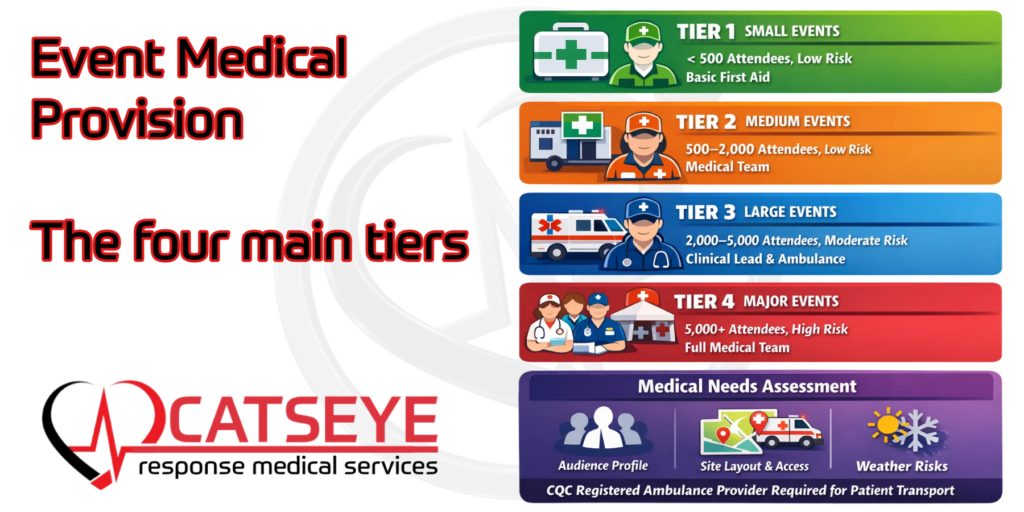
Catseye Response Medical Services structures its event medical provision using a clear four-tier system to ensure appropriate, scalable care for any setting.Event medical cover is typically structured across four tiers, based on crowd size, risk level, and event complexity. Here’s a simplified breakdown of what each tier involves and the level of provision you should expect.
Tier 1
Small, low-risk events (<500 attendees)
- Short duration, minimal risk factors, no alcohol or drug use.
- Provision: Basic first aid — a stocked kit and a competent person who can administer aid and contact emergency services.
Tier 2
Medium events (500–2,000 attendees)
- Low-risk activities, often involving social drinking, typically single-day.
- Provision: A nominated medical lead, professional responders and a clearly defined medical point.
Tier 3
Larger events (2,000–5,000 attendees)
- Increased likelihood of intoxication, moderate risk, often multi-day.
- Provision: A clinical lead (paramedic or nurse), a mixed clinical team, and at least one ambulance for hospital transfers.
Tier 4
Large, complex events (5,000+ attendees)
- High-risk environments, multi-day operations, complex logistics.
- Provision: Full multidisciplinary team (doctors, paramedics, nurses), on-site medical/triage facilities, and multiple ambulances.
Tier 1: Small & Simple Events
These include community gatherings like village fetes or small workshops, where hospital referrals are highly unlikely.
- Staffing: Typically 1–2 trained first aiders (often volunteers).
- Focus: Minor injuries such as cuts, grazes, or fainting.
- Infrastructure: Basic first aid kits and awareness of the nearest Public Access Defibrillator (PAD).
Tier 2: Medium-Sized / Low-Risk Events
Examples include local festivals, charity runs, or similar public events—often requiring local authority approval.
- Staffing: Professional event medical personnel led by a nominated medical lead.
- Infrastructure: A designated and clearly signposted first aid post or treatment room.
Tier 3: Larger / Moderate-Risk Events
This tier covers music festivals, large sporting events, or multi-day gatherings where serious illness or injury is foreseeable.
- Staffing: A clinical lead (registered healthcare professional with pre-hospital experience), supported by paramedics and nurses.
- Infrastructure: A fully equipped medical centre capable of patient monitoring.
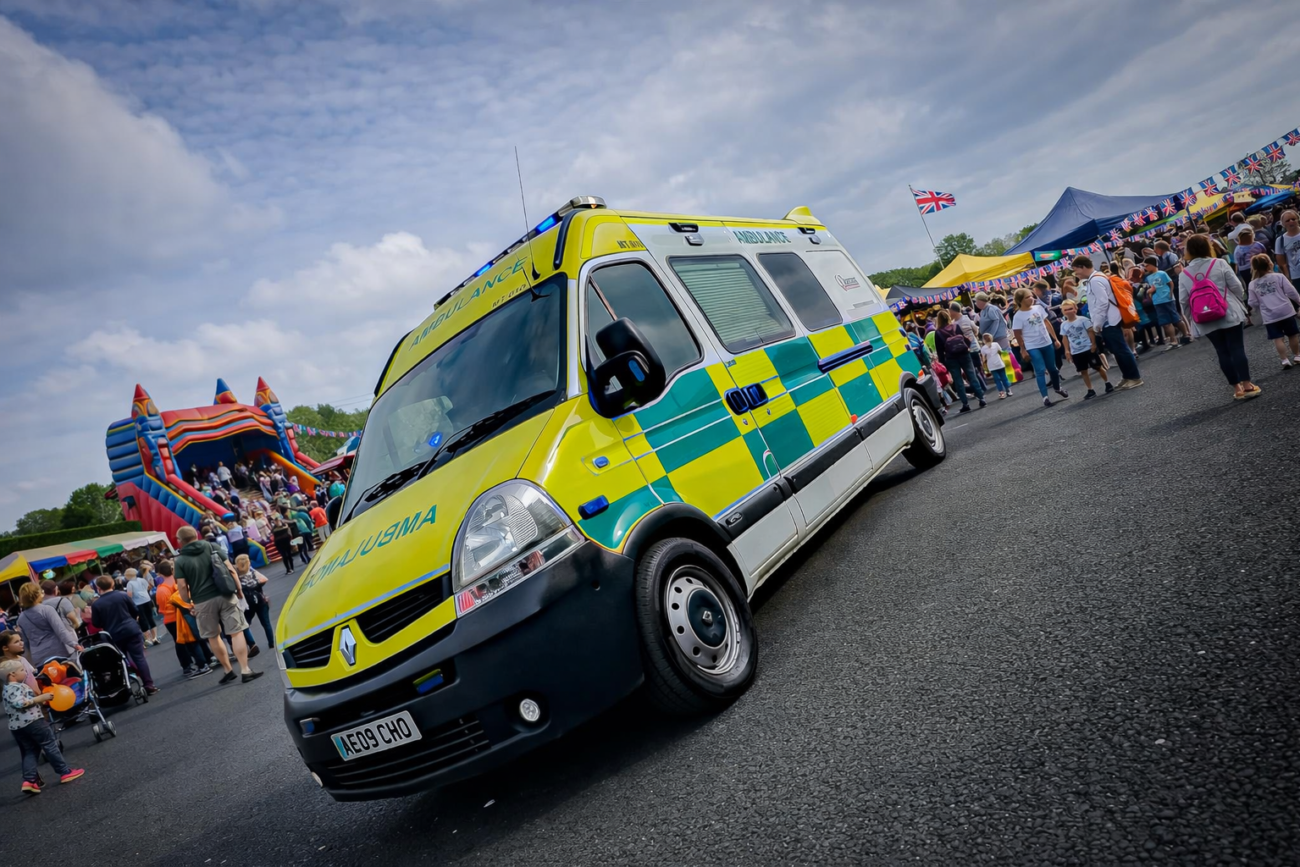
- Transport: At least one on-site ambulance to ensure hospital transfers don’t leave the event without cover.
Tier 4: Large & Complex Events
Major festivals and high-impact events require a structured, coordinated medical operation.
- Staffing: Multidisciplinary team including doctors (often emergency medicine or GP background), nurses, and paramedics.
- Infrastructure: On-site medical facilities with separate pathways for injury and illness.
- Management: Centralised command and control (e.g. radio dispatch) to coordinate multiple response teams across the site.
Critical Requirement: Medical Needs Assessment (MNA)
Regardless of tier, medical provision should never be based on crowd size alone. A proper Medical Needs Assessment (MNA) is essential.
Key considerations include:
- Audience Profile: Age range, likelihood of alcohol/drug use, and historical incident data.
- Site Layout: Distance to the nearest A&E department and accessibility for emergency vehicles.
- Environmental Factors: Weather conditions and associated risks (e.g. heat exhaustion or hypothermia).